
 By
Your company reports: "Net income $500K. EBITDA $2M. Adjusted EBITDA $4M."
The investor asks: "What's the difference?"
Net income = profit after expenses, taxes, and capital costs. EBITDA = operating profit before debt and depreciation. Adjusted EBITDA = operating profit before debt, depreciation, and one-time costs.
But here's the catch: there are no hard rules for what counts as "one-time." So management can be creative. Very creative.
This guide covers: what EBITDA and adjusted EBITDA are, common add-backs, why investors and auditors are skeptical, red flags for aggressive adjustments, and how consumer brands should present adjusted metrics to investors and banks.
EBITDA: The Baseline
The 50-word definition
EBITDA = Earnings Before Interest, Taxes, Depreciation, and Amortization. It shows operating profit before the impact of capital structure (debt vs equity) and non-cash charges (depreciation). Formula: Net Income + Interest + Taxes + Depreciation + Amortization
Why EBITDA matters:
- Removes capital structure impact: A company with $10M debt looks worse on net income than one with no debt, even if they operate identically. EBITDA removes this distortion.
- Removes non-cash charges: Depreciation and amortization are not cash outflows. They're accounting allocations. EBITDA shows cash-generating ability.
- Comparable across companies: EBITDA allows you to compare a debt-heavy company to a debt-light one on an apples-to-apples basis.
- M&A standard: Investment banks and PE firms value companies on EBITDA multiples (e.g., 8x EBITDA), not net income multiples.
EBITDA calculation example
Start: Net Income: $500K
+Interest Expense: $100K (debt on balance sheet)
+Income Tax: $150K (effective tax rate)
+Depreciation: $400K (buildings, equipment)
+Amortization: $150K (intangible assets)
EBITDA = $1.3M
EBITDA Margin = $1.3M / $5M Revenue = 26%
EBITDA is the number used in M&A valuations, bank lending agreements (leverage ratios), and investor presentations.
Adjusted EBITDA: Definition and Purpose
The definition
Adjusted EBITDA = EBITDA +/- adjustments for one-time, non-recurring, or extraordinary items. It's meant to show "normalized" operating profit on an ongoing basis, removing one-time noise to show the underlying business.
The logic: In any given year, a business may face unusual costs: restructuring, asset impairments, litigation settlements. These don't reflect ongoing business. So management "adjusts" EBITDA to show what earnings would be if the business was running normally.
Why it matters:
- Bank covenants: Lenders often require adjusted EBITDA > X amount. They want to see ongoing profit, not profit depressed by one-time costs.
- Investor expectations: Investors want to understand the "run-rate" business, not one-time events.
- Board reporting: Investors and board members use adjusted metrics to evaluate management performance.
- M&A multiples: PE firms value companies on adjusted EBITDA because they assume they can fix the one-time issues.
Example: A company reports EBITDA of $2M. But $1M of that is depressed by a one-time restructuring cost. Adjusted EBITDA is $3M: the ongoing run-rate.
Investors prefer to value based on the $3M (8x = $24M valuation) rather than the $2M (8x = $16M valuation).
Common Add-Backs and Their Justification
Not all add-backs are created equal. Some are obvious and widely accepted. Others are aggressive.
Tier 1: Widely Accepted Add-Backs (Low Skepticism)
| Item | Typical Amount | Justification | Auditor View |
|---|---|---|---|
| Restructuring / severance | $500K - $5M | One-time employee layoff or office closure | Generally accepted if documented and truly one-time |
| Asset impairment charges | $100K - $10M | Writing down asset value due to obsolescence or underperformance | Accepted; non-cash charge |
| Stock-based compensation (SBC) | $200K - $2M+ | Non-cash charge; dilutes equity but not an operating expense | Increasingly accepted; represents future dilution, not current cash spend |
| Acquisition-related costs | $50K - $1M | One-time legal, accounting, integration costs to acquire another company | Accepted; directly tied to one transaction |
| Litigation settlement | $100K - $10M+ | One-time payment to settle lawsuit | Accepted if truly a one-time event |
Tier 2: Defensible But Higher Scrutiny
| Item | Typical Amount | Why Skeptical | When It's OK |
|---|---|---|---|
| Insurance settlements / recoveries | $50K - $500K | Usually one-time, but can be recurring | Only if truly non-recurring (one-time claim) |
| Facility closure costs | $100K - $2M | One-time if it's a single facility; recurring if company is constantly downsizing | Only if this is the first/last closure, not a pattern |
| Consulting or professional fees for special projects | $50K - $500K | Can blur into regular operating expense | Only if it's clearly a one-time project (IPO prep, strategic review) |
| Foreign exchange losses / gains | $50K - $500K | Can be recurring if company operates globally | Only if the currency event was truly extraordinary |
Tier 3: Red Flags (High Skepticism)
These should almost never be added back:
- Recurring operating costs labeled "one-time": "We're adding back the $100K consultant who's been on payroll for 2 years because he's non-recurring." No. That's a regular expense.
- Loss on asset sale: If you bought equipment for $500K and sold it for $300K, the $200K loss is a reality of business operations, not a one-time event.
- Supplier discount or rebate: "We got a bulk discount that saved us $200K." That's a good thing, not an adjustment.
- Severance for repeated layoffs: "We laid off 10 people." If you're doing this every quarter, it's operating expense, not one-time.
- Change in accounting estimate: "We changed our reserve estimate, which increased EBITDA by $300K." That's a judgment call, not an add-back.
Why Auditors and Investors Are Skeptical
Auditors don't "sign off" on adjusted EBITDA. There's no accounting standard that says what can and can't be added back. So management can be creative.
As one Reddit commenter put it: "There's no rules around what can be considered adjusted EBITDA, so in the eyes of CPAs it's basically management making up a number."
The problem: Scope creep
Year 1: Company adds back $200K of legitimate one-time restructuring. Fair.
Year 2: Company adds back $200K of restructuring (again). They claim it's all one-time. But now it's a pattern.
Year 3: Company adds back $300K of restructuring. It's now 3 years in a row.
The adjusted EBITDA number keeps rising while actual profit stays flat. That's a red flag.
The investor perspective
Sophisticated investors do their own due diligence. They:
- Reconcile adjusted EBITDA back to audited net income. If the bridge is complicated or the add-backs are vague, they distrust it.
- Ask: "If these costs are truly one-time, why do they happen every year?" If the answer is weak, they reduce the valuation multiple.
- Look at cash flow. "You say adjusted EBITDA is $4M, but you're burning cash. Where's the disconnect?" This is the ultimate test.
- Compare to peers. "Your adjusted EBITDA margin is 40%; the peer average is 25%. How are you so much better?" Suspicious.
- Test the add-backs on their own. "You added back $1M in restructuring. But restructuring is part of normal business. Every company does it. Why is it one-time?"
The bank perspective
Banks are more lenient than investors. They use adjusted EBITDA in covenant calculations (e.g., "Leverage ratio < 3x adjusted EBITDA"). But they're not naive.
They ask: "Has this business actually paid down debt with this adjusted EBITDA?" If a company claims adjusted EBITDA of $5M but cash debt reduction is $1M, banks ask for a reconciliation.
From an investment banker's view: "Adjusted EBITDA only tricks you if you don't do your own DD. In M&A, literally nobody cares about net income. It's all about cash flow. I've worked with lots of closely held businesses where the owners and management team don't take any w2 compensation, so no payroll expense, only distributions. Or they take huge salaries and no distributions."
Red Flags: Aggressive Adjusted EBITDA
Warning signs:
- Adjusted EBITDA is much higher than EBITDA: If adjusted EBITDA is 150%+ of EBITDA, something is off. Large add-backs suggest an operating business in trouble.
- Add-backs are vague: "Other one-time costs" without itemization. Demand detail.
- Recurring items labeled one-time: Restructuring, consulting, or other costs that happen every year. By definition, not one-time.
- Ratio creep: Add-backs grow each year while revenue grows slowly. The adjusted number becomes less credible.
- Cash flow doesn't match: Adjusted EBITDA says $10M, but actual cash from operations is $3M. The gap is unexplained.
- Auditor qualifications: If the audit report says "Management's use of non-GAAP measures (like adjusted EBITDA) should be considered in context of GAAP measures," that's auditor-speak for "be careful."
For Consumer Brands: Worked Bridge, Defensible vs Aggressive Add-Backs, Investor Presentation
Consumer brands often present adjusted EBITDA to raise capital or refinance debt. The challenge: separating defensible (one-time, clearly non-recurring) from aggressive (recurring costs hidden as one-time). Investors and banks know the game. Here's how to present credibly.
Tier 1: Defensible add-backs for consumer brands (low skepticism)
| Adjustment | Example from Consumer Brands | Auditor/Investor View |
|---|---|---|
| Acquisition integration (one-time) | Acquired beauty brand. Legal fees $50K, duplicate systems removal $80K, severance for overlapping roles $200K. Total: $330K. | Widely accepted if one acquisition, fully documented. |
| Restructuring: warehouse closure or SKU rationalization | Closed regional fulfillment center. Severance $150K, facility exit costs $50K. | Accepted if one-time and not recurring (i.e., not every year). |
| Inventory write-down for slow SKU | Brand forecasted wrong on a new flavor. Excess inventory of 10K units. Marked down from $8 to $3/unit cost = $50K write-down. | Contested. Consumer brands write down inventory most years, so buyers often treat it as a recurring cost. One-time. |
| Stock-based compensation (SBC) | Series B funding: granted stock options to team. $200K dilution expense (FAS 123R). | Commonly added back, but many investors view SBC as a real cost. Show it separately so they can decide. |
| One-time channel launch spend | Launched Amazon FBA. One-time integration costs with Seller Central API, 3PL setup, Amazon Ads initial learning spend = $120K. | Accepted if it's the first and only time. If you launch channels every quarter, not "one-time." |
Tier 2: Red flags (high skepticism)
- Recurring marketing spend labeled "one-time": "We spent $150K to launch our influencer program. It's a one-time initiative." But you're running influencer campaigns every quarter. That's operating expense, not one-time.
- Annual founder bonus labeled "extraordinary": Founder takes $500K bonus in Q4 and says "it's discretionary." But they've done it every year. That's recurring.
- Consultant or agency fees that recur: "We hired a strategic consultant for $100K." But the consultant is on retainer ongoing. Recurring = OpEx, not add-back.
- Vague descriptions: "Other one-time costs: $200K." Investors will ask for detail and distrust vague buckets.
- Adjusted EBITDA that is 150%+ of EBITDA: If adjusted is 1.5x higher than reported, something is off. Large add-backs suggest an operating business in trouble.
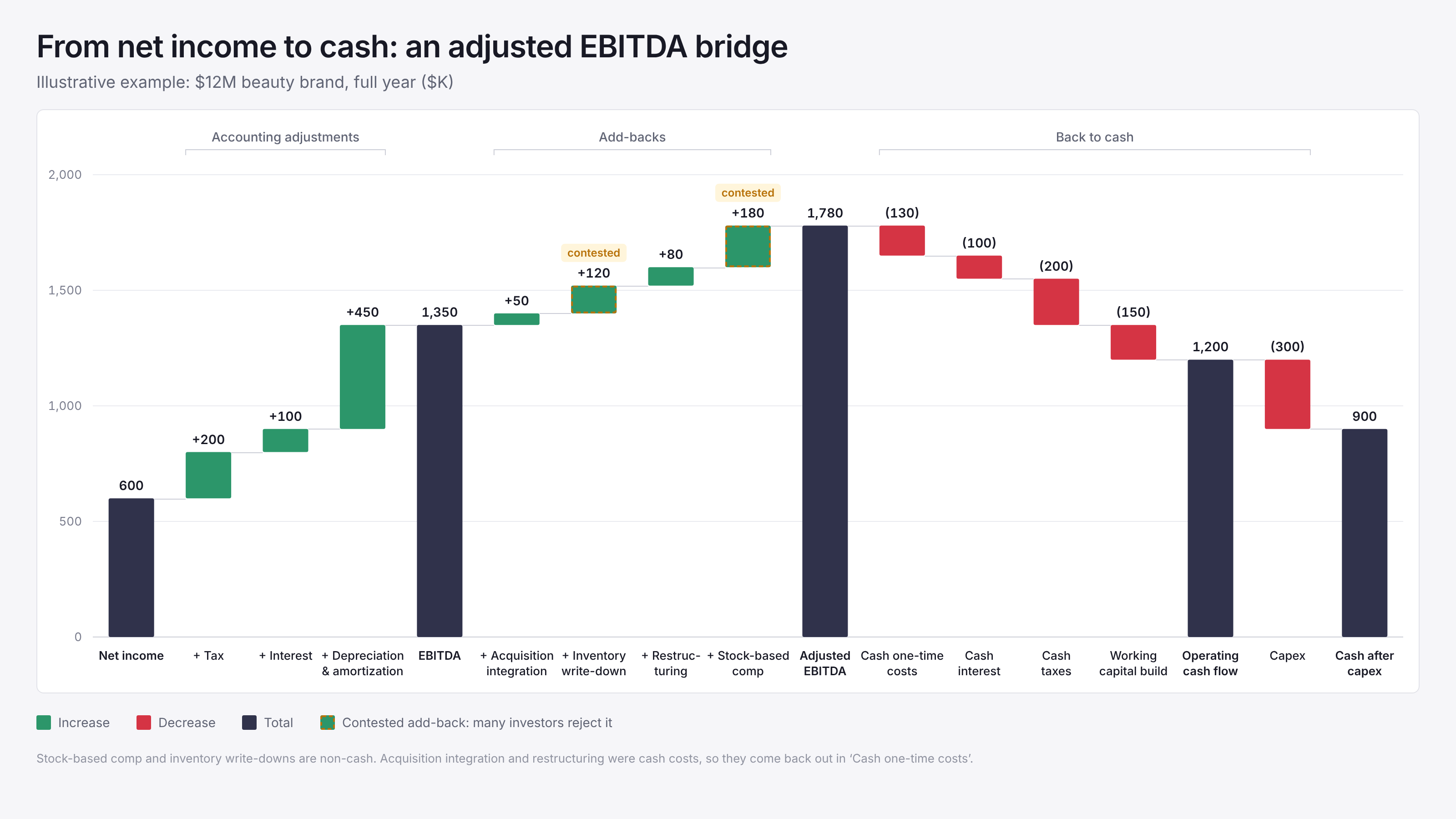
Worked example: Consumer brand EBITDA bridge (apparel/beauty brand, 2 years old)
Illustrative example: Beauty brand, $12M revenue, seeking $2M Series A
Q4 Financial Summary (Full Year)
From Audited Income Statement:
Revenue: $12M
COGS: $4.2M (35%)
Gross Profit: $7.8M
Operating Expenses: $6.9M
Operating Income (EBIT): $0.9M
Interest Expense: $100K (loan)
Income Tax: $200K
Net Income: $600K
Calculate EBITDA:
Net Income: $600K
+ Income Tax: $200K
+ Interest Expense: $100K
+ Depreciation (fulfillment equipment): $300K
+ Amortization (intangible assets from acq): $150K
EBITDA: $1.35M
EBITDA Margin: 11.25%
Add-Backs (Defensible):
+ Acquisition integration (acq 2 years ago, final costs): $50K (amortizing to zero)
+ Inventory write-down (discontinued SKU line): $120K (contested: many buyers reject write-downs as add-backs for consumer brands because they tend to recur; include only if tied to a line you have exited)
+ Restructuring: closed 2nd warehouse, consolidated to 3PL: $80K (severance $50K, exit costs $30K)
+ Stock-based compensation (option grants to team): $180K (common in adjusted EBITDA, but many investors treat SBC as a real cost, so show it as its own line)
Total Defensible Add-Backs: $430K
Add-Backs (Aggressive - DO NOT INCLUDE):
- Founder salary ($400K): do not simply add it back. Buyers normalize it to what a market-rate replacement would cost, which can raise or lower EBITDA.
- All influencer marketing ($200K): DO NOT. It's recurring every quarter. Operating expense.
- 3PL fees ($1M annually): DO NOT. That's a core operating cost, not one-time.
Adjusted EBITDA (Credible):
EBITDA: $1.35M
+ Defensible Add-Backs: $430K
Adjusted EBITDA: $1.78M
Adjusted EBITDA Margin: 14.8%
Credibility Test (Reconciliation to Operating Cash Flow):
Adjusted EBITDA: $1.78M
Less cash one-time costs that were added back (acquisition integration $50K + restructuring $80K): ($130K)
Less cash interest: ($100K)
Less cash taxes: ($200K)
Less working capital build (inventory and receivables, net of payables): ($150K)
= Operating cash flow: $1.20M, which ties to the cash flow statement.
Then subtract capex of $300K (an investing cash flow, not an operating one) to get cash after capex of $0.90M.
Stock-based comp ($180K) and the inventory write-down ($120K) are non-cash, so they need no cash adjustment. If you cannot walk adjusted EBITDA to operating cash flow line by line like this, expect investors to discount it.
Investor Presentation (Board Deck):**
| Metric | Full Year | Margin |
|--------|---|---|
| Revenue | $12.0M | |
| COGS | ($4.2M) | 35% |
| Gross Profit | $7.8M | 65% |
| Operating Expenses | ($6.9M) | 58% |
| Operating Income | $0.9M | 7.5% |
| Adjusted for One-Time Items | | |
| Add: Acq Integration | $50K | |
| Add: Inventory Write-Down | $120K | |
| Add: Restructuring | $80K | |
| Add: Stock-Based Comp | $180K | |
| Adjusted Operating Income | $1.33M | 11.1% |
| Add: D&A | $450K | |
| Adjusted EBITDA | $1.78M | 14.8% |
Commentary (credible language):
"Our net income for the year was $600K (5% margin). However, this includes several one-time items: acquisition integration costs ($50K; now complete), inventory write-down from a 2023 SKU launch ($120K; sunk cost), and restructuring from consolidating warehouses ($80K; one-time). Additionally, we granted equity options to the team in Q4 ($180K non-cash charge). Adjusting for these items, our underlying operating profit (adjusted EBITDA) was $1.78M (14.8% margin), representing the normalized cash-generating ability of the business. Our 2026 guidance assumes no major restructuring or acquisition costs, so adjusted EBITDA should be more in line with ongoing run-rate of 15% margin on $15M projected revenue = ~$2.25M Adjusted EBITDA."
Notice: We are NOT claiming these costs don't matter. We ARE claiming they are not representative of ongoing business. This is credible.
SEC Regulation G: Non-GAAP disclosure rules
If you're a public company (or filing with the SEC for a 144A offering), you must follow Reg G. For private companies seeking equity or debt:
- Always reconcile adjusted EBITDA back to audited GAAP net income. Line by line.
- Never present adjusted metrics without GAAP metrics side-by-side.
- Explain why each add-back is "non-recurring" or "extraordinary."
- If an add-back is larger than 10% of EBITDA, auditors may require a qualification ("management believes...but there are no defined standards").
Best practice for consumer brands raising capital
- 1. Conservative is credible: Add back only clearly defensible items. Investors prefer conservative numbers they believe in over aggressive numbers they discount.
- 2. Show the bridge: Investors will deep-dive into every line. Be ready to explain each add-back and defend its classification.
- 3. Test against cash flow: If adjusted EBITDA doesn't reconcile to operating cash flow, investors ask "where's the cash?" This kills credibility.
- 4. Trend it: If adjusted EBITDA was $1M last year and $1.78M this year, and add-backs doubled, investors get suspicious. "Why are one-time costs getting bigger?"
- 5. Use debt covenant language: Banks will ask: "Does your adjusted EBITDA calculation comply with our lending covenant definition?" Have this pre-agreed in your loan doc.
From Confusing Adjustments to Clear Reporting
Many consumer brands present adjusted EBITDA to investors and banks without proper reconciliation. The numbers look great. But investors drill deeper, find the bridge is weak, and lose confidence.
The better approach: start with audited net income. Show every add-back. Reconcile to adjusted EBITDA. Test against cash flow. This is how you build credibility with investors and boards.
FP&A for consumer brands is about presenting the truth clearly: what's the underlying run-rate profit? What's one-time noise? What's the cash-generating ability?
Stop presenting adjusted metrics without credible reconciliation.
Niblin's FP&A platform reconciles all financial metrics to audited numbers: EBITDA, adjusted EBITDA, operating cash flow, and contribution margin. Build boards that show clear bridges, no hand-waving, and investor-grade credibility. Live in weeks.
See how Niblin models it
Key Takeaways
- EBITDA = Net Income + Interest + Taxes + Depreciation + Amortization. It shows operating profit before capital structure and non-cash charges.
- Adjusted EBITDA adds back one-time or non-recurring items to show "normalized" run-rate profit.
- Common justified add-backs: restructuring, stock-based compensation, acquisition costs, asset impairments, litigation settlements.
- Red flags: add-backs that recur every year, vague descriptions ("other one-time costs"), or adjusted EBITDA that is 150%+ of EBITDA.
- Auditors don't sign off on adjusted EBITDA. There are no hard rules. Sophisticated investors do their own due diligence.
- The ultimate test: does cash flow support the adjusted EBITDA number? If not, credibility is lost.
- For consumer brands, always reconcile adjusted EBITDA to net income line by line. Test for recurrence. Back it with cash flow.
Frequently Asked Questions
What is adjusted EBITDA?
Adjusted EBITDA is EBITDA plus adjustments for one-time or non-recurring items. It's meant to show the cash-generating ability of the business on a normalized basis, excluding one-time costs like restructuring, acquisition costs, or impairments.
How is adjusted EBITDA different from EBITDA?
EBITDA is operating profit before interest, taxes, depreciation, and amortization. Adjusted EBITDA is EBITDA plus add-backs for one-time items. The goal is to show "normalized" profit by removing noise.
What can be added back?
Only truly non-recurring items: one-time restructuring, asset impairments, acquisition-related costs, stock-based compensation, litigation settlements. Items that happen every year (like annual bonuses or recurring marketing) should not be added back.
Why do auditors distrust adjusted EBITDA?
Because there are no standard rules for what can be added back. Management can be aggressive in labeling costs as "non-recurring" to inflate the number. Auditors sign off on GAAP financials (net income) but not on adjusted metrics.
Why do PE firms and banks care about adjusted EBITDA?
PE firms value companies using EBITDA multiples (e.g., 8x EBITDA). Banks use adjusted EBITDA in covenant calculations (e.g., Leverage < 3x). Both want to see "normalized" profit, not profit depressed by one-time events.
What are red flags for aggressive adjusted EBITDA?
Adjusted EBITDA much higher than EBITDA (150%+), vague add-back descriptions, items that recur every year, or cash flow that doesn't match the adjusted EBITDA number. Demand details and reconciliation.
Should consumer brands add back marketing spend for new channels?
Only if it's truly one-time. If you launch a channel once and incur high upfront marketing, that's a one-time event. If you launch a new channel every year, the spend is recurring and should be operating expense. Be consistent.