
 By
"I did it during a single budget cycle for a single group, it was both a dream and a nightmare. It was a big roadshow with detailed conversations. In my head it was how budgeting should be. I wish there would be a bigger push to zero base on a more standard cycle but everyone would rather just pull historical actuals and apply some assumptions."
— Source: r/FPandA (22 upvotes)
Most companies budget the same way every year: take last year's spend, add 5-10%, and call it the budget. It's easy, it's fast, and everyone understands it.
But it embeds last year's inefficiencies, misallocations, and sacred cows forever. If you spent $1M on a marketing tool five years ago and it's now obsolete, you still budget $1M because "that's what we've always spent."
Zero-based budgeting (ZBB) is the alternative: instead of starting with last year and adding growth, you start from zero and require every expense to be justified.
It's powerful. It also takes time and creates friction. This guide explains what ZBB is, when to use it, why most companies do it infrequently (not annually), and how to make it work.
What is Zero-Based Budgeting?
Zero-based budgeting (ZBB) is a budgeting method where you start from $0 and build the budget from scratch, justifying every single expense before it's included. There is no "last year's budget plus growth" baseline.
Instead of asking "What did we spend last year?", you ask "What do we need to spend to achieve our goals?" Every cost center submits a detailed plan of what they need and why.
The core principle
Each expense is evaluated on its own merit:
- Is this activity necessary? Does it contribute to our strategic goals?
- What is the expected outcome? If we spend $X, what do we get in return?
- Is this the most efficient way? Could we achieve the same outcome for less?
- Do we need this at all? Or can we reallocate to higher-value activities?
Traditional budgeting: "We spent $2M on customer support last year, so let's budget $2.1M (5% growth)."
Zero-based budgeting: "We have 10,000 customers. Support reps cost $60K/year. We need 5 reps to hit our SLA. Cost: $300K. We also need ticketing software ($50K) and training ($20K). Total: $370K. Here's why we need all of it."
How Zero-Based Budgeting Works
Step 1: Define outcomes, not inputs
Start with the question: "What are we trying to accomplish?" Not "How much should we spend?" but "What outcome do we need?"
Example: Sales department needs to close $50M in revenue. They work backward: "To close $50M, we need X pipeline. To generate X pipeline, we need Y sales development reps and Z marketing spend."
Step 2: Build detailed operating plans
Each department submits a detailed plan showing:
- Headcount: which roles, at what cost
- Tools and systems: software subscriptions, hardware, SaaS
- Vendor and contractor spend
- Travel and other operating expenses
- Initiatives: what projects will we fund and why
Every line item must be justified. "We're adding 2 engineers at $150K each ($300K) because we need to scale our API. Hiring timeline: Q2. Ramp time: 3 months. Expected impact: API throughput increases 2x."
Step 3: Review and challenge
Finance and leadership review each department's plan:
- Is this necessary? "Why do we need 3 account managers for customer support? Could 2 do it?"
- Is there a better way? "You want to hire 2 engineers. Have you considered a freelancer or outsourced team?"
- What's the ROI? "You're spending $500K on this initiative. What's the expected return in revenue or cost savings?"
This is where the conversations happen. Department heads have to defend their budgets, not just accept a top-down cut.
Step 4: Prioritize and allocate
Once all departments have submitted, you aggregate and prioritize:
- Tier 1 (essential): Core operations, must-haves
- Tier 2 (important): Growth initiatives, strategic projects
- Tier 3 (nice-to-have): Operational improvements, nice-to-have tools
If total budget exceeds capacity, you cut from Tier 3 first, then Tier 2. Tier 1 is protected.
Step 5: Lock and monitor
Budget is locked. Throughout the year, you track actual spend vs budget and monitor whether justified activities are delivering expected outcomes.
Zero-Based vs Traditional Budgeting
| Dimension | Traditional Budgeting | Zero-Based Budgeting |
|---|---|---|
| Starting point | Last year's actual spend + growth % | $0, justify everything |
| Time to build | 4-6 weeks | 8-12 weeks |
| Department involvement | Light (plug last year + X%) | Heavy (detailed build) |
| Conversations | Few; mostly negotiation on % growth | Many; detailed justification of each expense |
| Outcome | Easy to build, embeds historical inefficiencies | Harder to build, identifies waste, fresh thinking |
| Best for | Stable companies, fast budget cycles | Cost reduction, organizational change, new ventures |
| Frequency | Every year (standard) | Every 3-5 years or during major change |
When Zero-Based Budgeting Works
Best use cases
- Cost reduction initiatives: You need to cut $2M in spend. ZBB forces the conversation about what's truly necessary.
- New ventures or startups: You're building from scratch anyway. ZBB ensures you build only what you need.
- Organizational restructuring: You're changing roles or departments. ZBB ensures the new structure is optimized.
- Post-acquisition: You've merged two companies. ZBB eliminates duplicate functions and wastes.
- Major strategic shift: You're entering a new market or changing your business model. ZBB aligns spend with the new strategy.
- Low-trust situations: You suspect departments are sandbagging or hiding waste. ZBB brings transparency.
- Headcount planning: Headcount is usually ZBB even in traditional companies: you justify every role.
When traditional budgeting is fine
- Mature, stable business with predictable costs
- Fast-moving business where you can't afford a 3-month budget cycle
- Company with strong historical data and low waste
- Annual budget refresh where ZBB was done 3-5 years prior
The trade-off is clear: ZBB is thorough but slow. Traditional is fast but prone to embedding inefficiencies.
Why Most Companies Don't Do Zero-Based Budgeting Annually
The challenges
- Time commitment: ZBB takes 8-12 weeks to do well. The annual budget cycle is already 4-6 months. Adding ZBB pushes it to 5-7 months. For many companies, this is too long.
- Department friction: Asking teams to justify every expense, every year, creates fatigue and resistance. People feel constantly questioned.
- Limited benefit after the first cycle: The first time you do ZBB, you find significant waste (outdated tools, duplicate functions, inefficient processes). But after you clean that up, the benefit of annual ZBB is lower. You're doing detailed reviews of already-optimized budgets.
- Changing assumptions: ZBB assumes you're building the right thing. But in a mature company, the need changes: you're not rebuilding from scratch; you're evolving. Incremental budgets (last year + growth) reflect that.
- Governance complexity: ZBB requires more detailed tracking and justification throughout the year. You can't just compare actual vs budget; you have to track whether justified activities delivered expected outcomes. That overhead is significant.
One Reddit FP&A professional puts it bluntly: "Zero based budget as something you can do once every 3-5 years, or in the context of an organizational change... But too much effort and little value if you're already running a reasonably tight ship. Everyone would rather just pull historical actuals and apply some assumptions."
Another notes: "We do ZBB for our initial plan, then build off of it as periods actualize. It requires a lot more research and conversations with business partners but I think it is the way it should be done, at least for the first full year plan."
The reality
Most companies use ZBB infrequently: once every 3-5 years, or when triggered by a major change (new leadership, major restructuring, acquisition, significant cost pressure).
In off-years, they use traditional budgeting: last year + assumptions.
Best Practices for Using Zero-Based Budgeting Effectively
If you decide to do ZBB, here's how to make it work:
- Pick a trigger, not a cadence: Don't do ZBB every year. Do it when you have a reason (cost reduction, restructuring, new CFO). Off-years, use incremental budgeting. This avoids fatigue.
- Start with high-spend areas: If you have $50M OpEx, focus ZBB on the $20M (top 40%) of spend. Don't try to zero-base $100K contracts; focus on $5M+ items.
- Limit scope: You can do ZBB for one department or cost center (e.g., "Zero-base all non-engineering OpEx") and traditional for others. This manages the time commitment.
- For headcount, always use ZBB: Even if you use traditional budgeting for OpEx, consider headcount separately with ZBB. Every role should be justified.
- Set clear success metrics: "We will reduce OpEx by $2M through ZBB." "We will eliminate 3 duplicate roles." Having a target prevents endless discussion.
- Make it collaborative, not adversarial: Frame ZBB as "How do we fund our strategy optimally?" not "Where are you wasting money?" This keeps teams engaged.
- Track outcomes: When a department justifies an initiative, measure whether it delivered. "We budgeted $500K for customer support tools to reduce response time by 30%. Did we hit that?" Accountability drives honesty.
Common pitfalls to avoid
- Endless justification: Department heads can argue forever. Set a decision deadline: "By Nov 15, I will decide whether to fund each initiative. No further discussion after that."
- Moving budgets between lines: Teams try to disguise old spending under new names. Use consistent cost center structure to catch this.
- Overestimating cuts: ZBB often finds 5-10% of spend that's truly wasteful. If you cut 20%, you're cutting legitimate activity. Be realistic.
- Not following through: If you ZBB a department but then let them spend 20% above budget throughout the year, you signal that the budget doesn't matter. Enforce it.
For Consumer Brands: Zero-Based Budgeting for Marketing and Fulfillment
For consumer brands, ZBB is particularly effective for marketing and fulfillment spend, where channels have different economics and it's easy to hide inefficiency. Here are two worked examples: one for DTC marketing, one for fulfillment operations.
Worked example 1: DTC marketing ZBB
Illustrative example: instead of "we spent $1.5M on ads last year, so budget $1.67M," build marketing spend up from what the revenue actually requires. All figures are example assumptions.
- Goal: $5.0M DTC revenue. COGS is 50% and fulfillment 6%, so contribution before marketing is 44% = $2.2M.
- Last year's habit: budget marketing to a 3.0 MER (revenue / total marketing spend) = $1.67M. Contribution after marketing = $2.2M - $1.67M = $0.53M, or 10.7% of revenue.
- The target: leadership wants 25% contribution after marketing = $1.25M. That caps marketing at $2.2M - $1.25M = $0.95M, a required MER of 5.3 ($5.0M / $0.95M).
- Build from zero: split revenue by who buys. Returning customers bring $2.25M (45%) and need only retention spend (email and SMS): $0.10M. New customers must bring $2.75M. At a $110 first-order value, that is 25,000 new customers. To stay within $0.95M, new-customer spend can be $0.85M, so blended CAC must be $34 or less.
- Test the assumption: if your recent paid CAC is $45, 25,000 new customers cost $1.125M. Total marketing = $1.225M, and contribution falls to $0.975M (19.5%).
- Decision: either accept 19.5%, lower the new-customer target, raise first-order value (bundles, price), or grow the returning-customer base so less revenue depends on paid acquisition. Each choice is now explicit instead of buried in a 10% uplift.
This is the ZBB question in one line: "Is $1.67M required to hit $5M, or can we do it for less?" Incremental budgeting never asks it.
Worked example 2: Fulfillment operations ZBB
A 3PL invoice is often a black box: "we pay $X per order," and no one asks whether that is the right cost. ZBB rebuilds it from the activities underneath.
Illustrative example: fulfillment cost built from zero (50,000 orders a month, DTC plus Amazon FBM)
| Cost line | Build-up | Per month |
|---|---|---|
| Warehouse space | 25,000 sq ft x $12 per sq ft per year / 12 | $25.0K |
| Pick, pack and receiving staff | 50,000 orders / 20 days / 250 orders per person per day = 10 FTE x $45K fully loaded / 12 | $37.5K |
| Warehouse manager | 1 FTE x $85K fully loaded / 12 | $7.1K |
| WMS software and equipment | Example quote | $3.0K |
| Packaging | $0.75 x 50,000 orders | $37.5K |
| Outbound shipping | $4.50 x 50,000 orders | $225.0K |
| Returns processing | 5% x 50,000 x $1.50 | $3.75K |
| Total | $6.78 per order | $338.85K |
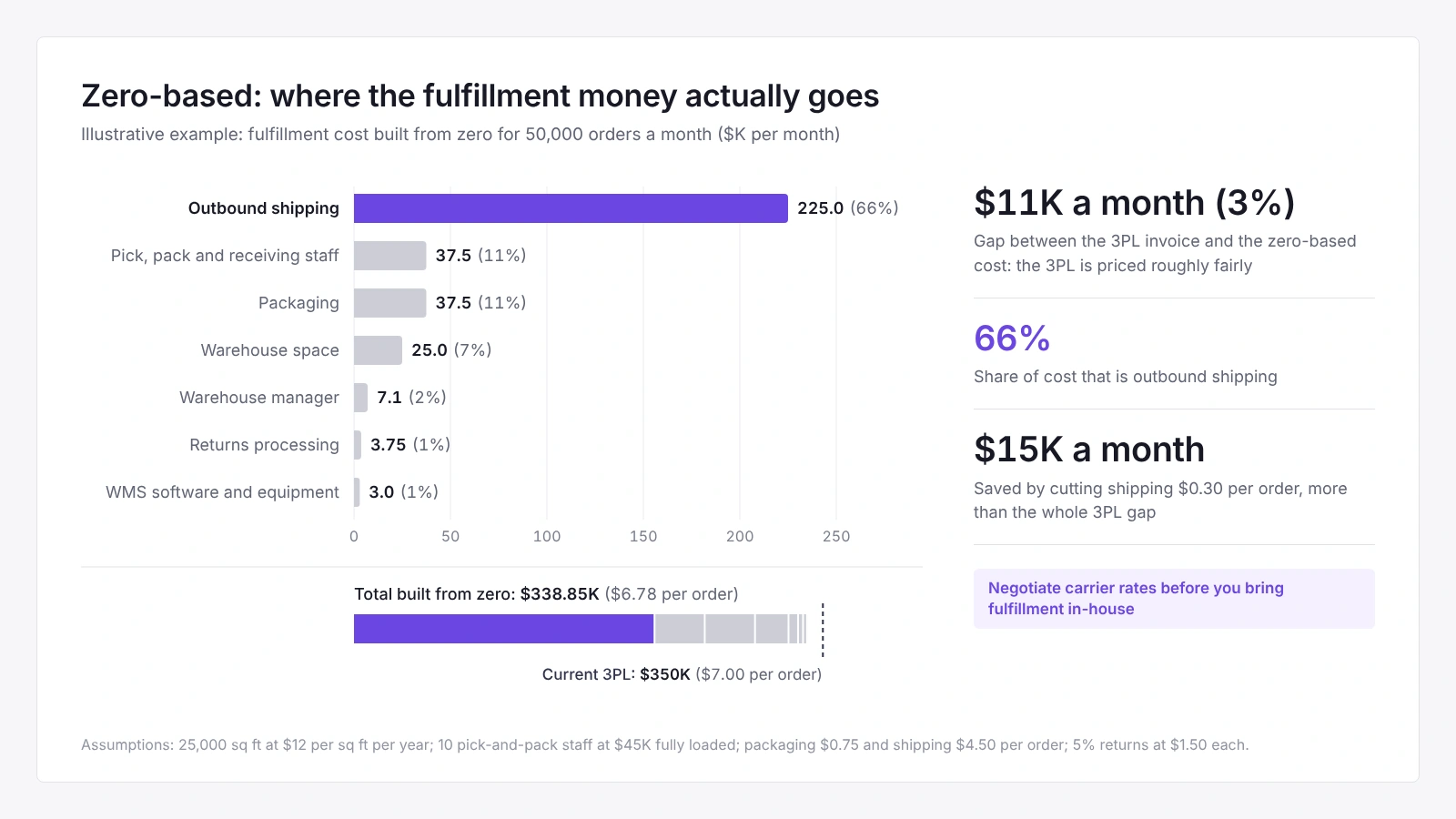
- Current 3PL spend: $350K a month ($7.00 per order).
- Gap: about $11K a month (3%). Running fulfillment in-house would save little and add operational risk, so the 3PL is priced roughly fairly.
- Where ZBB actually points: outbound shipping is $225K of the $339K (66%). The lever is carrier rates, zone skipping and package dimensions, not the 3PL's handling fee. A $0.30 cut in shipping per order is worth $15K a month, more than the whole in-house gap.
That is the real value of ZBB: not cutting every line by 10%, but finding the one line where the money is.
Using Zero-Based Budgeting to Clean Up Spend
Zero-based budgeting is a powerful tool, but it's not a silver bullet. It works best when you have a clear goal (reduce cost, clean up after an acquisition, align to new strategy) and you use it selectively, not every year.
The companies that get the most out of ZBB are those that do it once every 3-5 years, learn what waste exists, eliminate it, and then maintain discipline through incremental budgeting in the off-years. This balance gives you the insight of ZBB without the annual burden.
For consumer brands selling across multiple channels with different cost structures, ZBB can reveal which channels are truly profitable and where spend is misallocated. When you rebuild the budget from the ground up, based on contribution margin and channel profitability, spending decisions become much clearer.
Make every dollar count: use ZBB when it matters.
Niblin's FP&A platform lets you model channel-by-channel profitability and scenario-test budget decisions: "If we shift $500K from DTC to Amazon, how does this impact margin?" See the impact across all channels and SKUs, without manual rework.
See how Niblin models it
Frequently Asked Questions
What is zero-based budgeting?
Zero-based budgeting (ZBB) starts from $0 and requires justifying every expense before it's included in the budget. Instead of "last year's spend plus growth," you ask "what do we need to spend to achieve our goals?" and build from there.
How does zero-based budgeting differ from traditional budgeting?
Traditional budgeting starts with last year's spend and adds a growth percentage. ZBB starts from zero and justifies every line item. Traditional is faster and easier; ZBB is more thorough and can uncover waste but takes longer.
When should we use zero-based budgeting?
ZBB works well during cost reduction initiatives, organizational restructuring, post-acquisition integration, major strategic shifts, or when you suspect significant waste. For stable companies in normal years, traditional budgeting is often sufficient.
Why don't most companies do zero-based budgeting every year?
ZBB takes 8-12 weeks to execute well, extending the already-long budget cycle. After the first cycle, much of the benefit diminishes (waste has been identified and removed). The effort is justified infrequently: every 3-5 years or when triggered by a major change.
How long does zero-based budgeting take?
Plan for a longer cycle than a normal budget, from kick-off to final approval. This includes: defining outcomes, departments building detailed plans, finance review and challenge, prioritization, and board approval. It takes noticeably longer than an incremental budget because every cost is rebuilt from zero.
Can we do zero-based budgeting for just one department?
Yes. You can ZBB one department or cost center (e.g., "zero-base all non-engineering spend") and use traditional budgeting for others. This manages the time commitment while still driving rigor where you need it most.