
 By
"3 months all in. Never 2. Sometimes 4. We do a bottom up budget, and then inevitably there's a top down budget done afterwards, and then a reiteration to get it down to the number, and then a one line adjustment "savings" in each cost centre. The final budget will be called Budget v12."
— Source: r/FPandA (63 upvotes)
The annual budget process is where strategy meets reality. It's also where teams negotiate, compromise, hope, and sometimes hide assumptions.
For a small company, it might be a two-person conversation in Excel. For a mid-market or large company, it's a months-long process involving dozens of people, dozens of versions, and sometimes heated disagreements about what numbers are realistic.
The challenge: running a budget process that produces realistic targets that teams believe in, that the board approves, and that can actually be achieved.
This guide walks through how to design and execute an annual budget process, including timelines, methods, the challenge of sandbagging, and how to govern the process so it produces actual insights instead of performance theater.
The Budget Process at a Glance
Most companies follow a similar pattern:
- July-August: Finance and leadership agree on strategic assumptions (revenue growth rate, headcount plan, major investments).
- August-September: Finance publishes budget guidelines and templates. Departments submit first-pass budgets based on historical spend and growth assumptions.
- September-October: Finance consolidates, analyzes, and flags mismatches. "Finance projects $50M revenue, but sales submitted a budget that requires $60M to hit margins."
- October-November: Leadership does a top-down adjustment. "We need $55M revenue and 15% EBITDA. Department heads, adjust your plans to get there."
- November: Reiteration. Departments resubmit. Finance consolidates again. Multiple versions (v2, v3... v12 is not uncommon).
- Late November: Final board approval. Budget is locked.
- January 1: Budget is published. It is the baseline for the year.
The whole process takes 4-5 months. For a large company with many business units or geographies, it can take 6+ months.
Budget Calendar: A Realistic Timeline
Illustrative example: Mid-market company targeting Nov 30 approval
| Week | Timing | Phase | Participants | Key Deliverables & Decisions |
|---|---|---|---|---|
| Week 1 | Week of Jul 1 | Kickoff | CFO, CEO, Board Finance Committee | Strategic assumptions locked: revenue growth target, gross margin target, headcount envelope, capex plan. Budget calendar published. |
| Week 2 | Week of Jul 8 | Template prep | Finance | Excel model completed. Guidelines doc, assumptions sheet. Department templates finalized and tested. |
| Week 3 | Week of Jul 15 | Launch | Finance to all departments | Templates, guidelines, and instructions sent. Finance hosts kickoff meeting (optional for questions). |
| Week 4 | Week of Jul 22 | Department work week 1 | All department heads | Sales: build revenue budget by customer segment. Ops/fulfillment: forecast headcount/costs by order volume. Marketing: budget by channel (DTC, Amazon, wholesale). |
| Week 5 | Week of Jul 29 | Department work week 2 | All department heads | Continued work. Finance available for questions via Slack. Any clarifications on assumptions handled daily. |
| Week 6 | Week of Aug 5 | First submission deadline | All departments | All first-pass budgets due by end of day Friday. Finance immediately loads into consolidation model. |
| Week 7 | Week of Aug 12 | Finance review & gap analysis | Finance team | Check: Do numbers add up? Does revenue budget match plan assumptions? Are there red flags? Consolidate by the following Monday. |
| Week 8 | Week of Aug 19 | Leadership review & Q&A | CFO, VP Finance, CEO + selected department heads | Review consolidated budget Mon-Wed. Finance presents gap analysis. Department heads clarify assumptions Thu-Fri. "Why is marketing up 40%? What's the ROI driver?" |
| Week 9 | Week of Aug 26 | Top-down targeting | CEO, CFO | CEO decision by Wednesday: for example, "We need $12M revenue and 16% contribution." Finance models impact: which departments absorb cuts? By Fri, send reiteration instructions to departments. |
| Week 10 | Week of Sep 2 | Labor Day + reiteration | All departments | Department heads revise budgets to meet top-down targets. Resubmit by Friday (watch for the US Labor Day holiday in this window). |
| Week 11 | Week of Sep 9 | Finance consolidation 2 | Finance team | Rebuild model with resubmitted budgets. Check math. Identify any remaining gaps by Thursday. |
| Week 12 | Week of Sep 16 | Scenario & board prep | CFO, Finance | Build 2-3 scenarios: base case, upside (if new product launches), downside (if market slows 10%). Prepare board presentation deck. |
| Week 13 | Week of Sep 23 | Board finance committee meeting | CFO, Board Finance Committee | Present budget, key drivers, risks, and scenarios. Board may approve, request revisions, or ask for data. Get feedback by EOD Wed. |
| Week 14 | Week of Sep 30 | Revisions (if needed) | Finance + departments (if major changes) | Incorporate board feedback. If only minor tweaks, take care by Wed. If major changes, loop back with departments Thu-Fri for input. |
| Week 15 | Week of Oct 7 | Final board approval | Full Board | Budget presented and approved (typically at full board meeting or by written approval). CFO publishes "APPROVED" version. |
| Week 16-17 | Mid to late Oct | Implementation & comms | Finance, All departments | Load budget into system. Share final budget with all departments. Connect to payroll, headcount tracking, and bonus structures. Training on tracking tools. |
| Week 18 | Week of Oct 28 | Lock & close | Finance | Budget is officially locked. Tracking starts the following Monday. |
| Week 19 | Week of Nov 4 | Go-live | All departments | Budget is the baseline for next year. Monthly close begins. Actuals vs budget tracking live. First forecast cycle runs after Jan 31 close. |
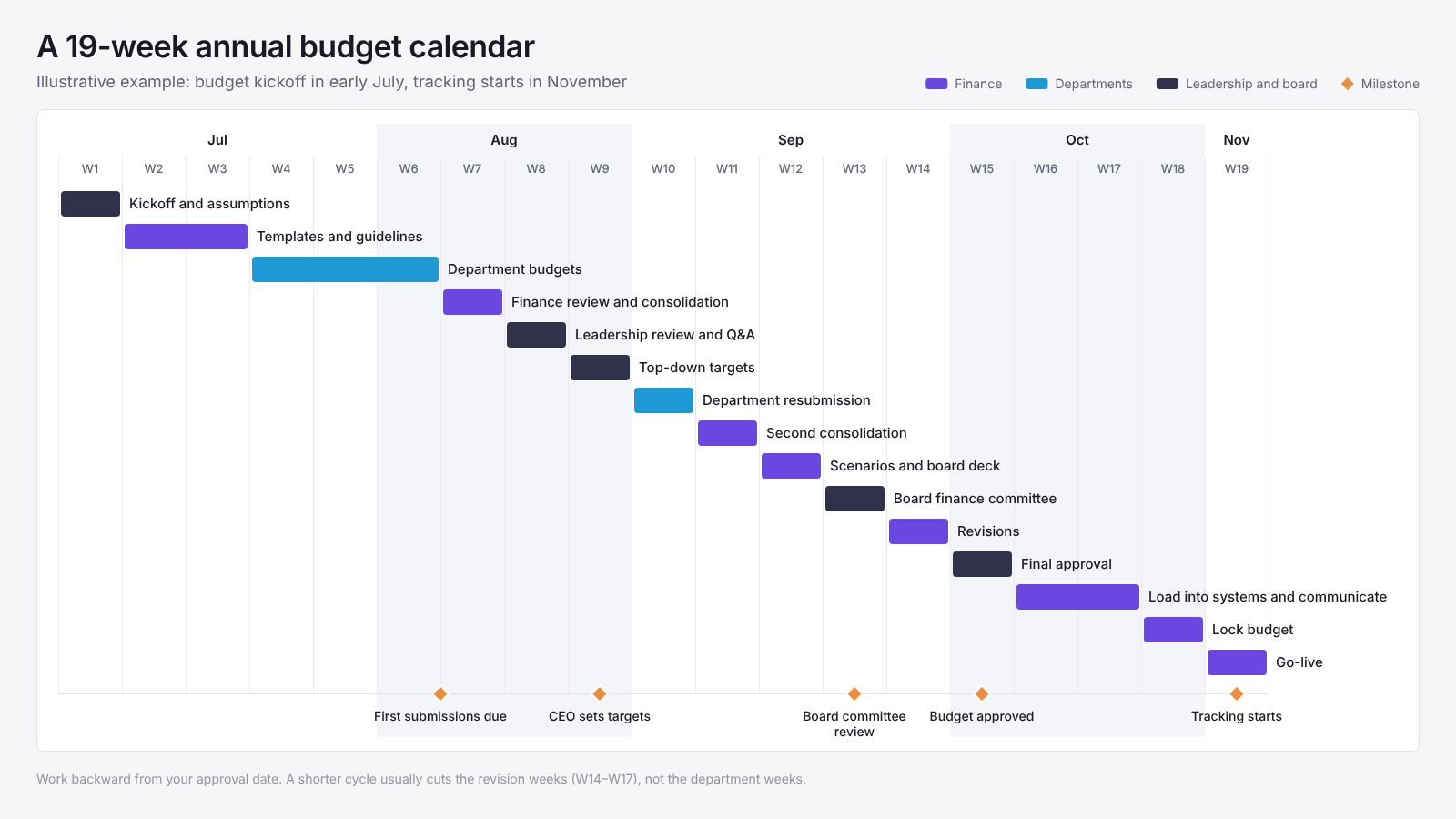
This week-by-week timeline shows a 19-week cycle (July 1 to November 1). Total duration: 4.5 months. Most companies fit this schedule. A 12-week "fast-track" would compress to July-September (cutting Week 14-17 refinement). A 24-week cycle would add iterations and extend into December.
Pro tip: Fix your budget approval date first (usually Nov 30 or Dec 15 to align with fiscal year-end accounting), then work backward. If you need approval by Dec 15, start kickoff by Aug 1. If you want approval by Oct 31, start by Jul 15. This prevents the "we're not ready" scramble in November.
Bottom-Up vs Top-Down Budgeting
Bottom-Up Budgeting
Bottom-up: each department or cost center builds their own budget from scratch, starting with their own assumptions (headcount plans, spend needs, revenue expectations).
Process:
- Sales: "We have 3 sales reps. Each can close $20M. We'll hire 2 new reps in Q2. Total revenue: $100M."
- Marketing: "We need to spend $5M on ads to acquire customers at our target CAC. We're budgeting $5M."
- Engineering: "We need 15 headcount + $2M in tools and cloud. Total: $3M."
- Finance: "Consolidate. Total: $100M revenue, $50M OpEx. Margins: 50%."
Pros: Department heads own their numbers. Details are worked through. Budgets are grounded in operational reality.
Cons: Takes a long time (multiple iterations). Departments may lowball revenue or sandbag expenses. May not align with board/investor expectations.
Top-Down Budgeting
Top-down: leadership (CEO, board) sets a target (e.g., "50% revenue growth, 30% EBITDA"), and finance works backward to allocate resources and costs.
Process:
- Board: "We're targeting 50% revenue growth (from $50M to $75M) and 30% EBITDA."
- Finance: "At 50% growth, gross margin will be flat. To hit 30% EBITDA, we have $15M OpEx ($75M x 20%). Currently we spend $12M, so we can add $3M."
- CEO: "Allocate that $3M: $2M to sales (for new reps), $1M to engineering."
- Finance: "Now allocate the $75M revenue target across sales regions based on last year's mix and growth assumptions."
Pros: Clear targets. Faster. Forces discipline (is the revenue target realistic given capacity?).
Cons: May miss operational details. Teams may not buy into stretch targets. If targets are unrealistic, demoralizes teams.
Best practice: Hybrid approach
Most successful companies do bottom-up first, then top-down overlay.
Department heads submit bottom-up budgets (Month 1-2). Finance consolidates. If the totals don't match strategic expectations, leadership sets top-down targets (Month 3), and departments iterate to get there.
This gives you the best of both: operational detail from bottom-up, plus strategic alignment from top-down. The downside: more iterations and longer process.
Key Steps in the Budget Process
Step 1: Set Strategic Assumptions
Before any department submits a budget, agree on company-wide assumptions:
- Revenue growth rate: e.g., 30% YoY (tied to plan and market expectations).
- Gross margin: e.g., stable at 65% (or improving if new products launch).
- Operating expense budget: How much can OpEx grow? If revenue grows 30%, does OpEx grow 20%?
- Headcount plan: Total headcount target. Hiring timeline.
- Major investments: New systems, facilities, initiatives.
- Capital expenditure: Equipment, buildout, tooling.
Document these in a "Budget Assumptions" document and share with all departments. This keeps everyone aligned.
Step 2: Distribute Templates and Guidelines
Create standardized Excel templates that make it easy for departments to submit comparable budgets:
- Revenue by product line / customer segment / geography
- COGS by cost category
- Operating expenses broken down by cost center
- Headcount plan (current HC + new hires + attrition)
- Capital expenditure requests
Include a "Notes" tab where departments explain key assumptions. This is important: it helps you understand the "why" behind the numbers.
Step 3: Collect First-Pass Budgets
Set a firm deadline a few weeks after templates go out, and publish it with the templates. Each department submits their budget based on bottom-up assumptions.
Common approach: "Budget revenue assuming X% growth from last year. Budget OpEx assuming Y% growth, or explain if different."
Step 4: Finance Consolidates and Reviews
Finance team (you) does the work:
- Check math (does revenue - COGS - OpEx = the profit margin we expect?)
- Check alignment (does total revenue budget align with strategic assumptions?)
- Spot gaps ("Sales budgeted $10M revenue but forecasted only $8M COGS. That's 80% margin, above our company norm.").
- Spot inconsistencies ("Engineering budgeted 5 new hires; HR says 0 new hires approved.")
Create a summary showing: total revenue, gross margin, OpEx, EBITDA, as % of revenue. Compare to prior year and strategy.
Step 5: Leadership Sets Top-Down Targets (if needed)
If the bottom-up budget doesn't match expectations, leadership intervenes:
- "Finance projects $45M revenue, but we need $50M to fund growth plans. Sales team, get to $50M."
- "Total OpEx is $25M. We targeted $22M. Each department, cut 5-10%."
This creates the famous tension: departments want easier targets (to hit bonuses), but leadership needs realistic targets (to fund the business).
Step 6: Reiteration and Refinement
Departments resubmit with top-down constraints. Finance consolidates again. Usually 2-3 rounds of iteration are needed to converge.
Step 7: Board Review and Approval
CFO presents to the board (finance committee or full board):
- Budget highlights: revenue, gross margin, OpEx, EBITDA
- Key drivers: "Revenue driven by X new products, 3 new sales reps, 15% price increase."
- Risks: "Dependent on new product launch in Q1; supply chain delay could impact Q2-Q3."
- Scenarios: Board may ask "What if revenue is 10% below? What do you cut?"
The board approves, asks for revisions, or rejects and sends back for rework.
Step 8: Final Publication and Sign-Off
Budget is finalized, locked, and published to all departments. Finance loads it into the financial system. Compensation committees tie bonuses to budget targets.
Managing Sandbagging and Lowballing
Sandbagging (or lowballing) is the practice of submitting deliberately conservative budgets to make hitting targets easier.
Example: Sales VP knows the team can close $50M but budgets $45M. When they exceed budget by $5M, they get a bonus. The company gets the revenue, but the profit target was always set too low.
Why sandbagging happens
- Bonus incentives: If bonuses are tied to hitting budget, teams want an easy target.
- Risk aversion: Conservative is safer than aggressive.
- Blame protection: "We exceed budget" looks better than "we miss budget."
- Negotiation: Teams assume leadership will negotiate them down, so they start high and sandbag.
The cost of sandbagging
- Profit targets become unreliable.
- Investors and the board lose confidence in management (if budgets are consistently easy).
- Cash forecasts are wrong, and you may fail to plan for investments.
- Resource allocation suffers (you allocate based on budgeted need, not real need).
How to prevent it
- Separate targets from bonuses: Set budget targets for accountability, but tie bonuses to broader metrics (gross margin, EBITDA %, customer retention) rather than hitting revenue budget.
- Look for patterns: If a department consistently exceeds budget by 15%, that's a sign they're sandbagging. Address it.
- Require documentation: "Explain the assumption behind your revenue budget. Show me the pipeline, closed deals, and conversion assumptions."
- Stress-test assumptions: "You budgeted 3 new sales reps producing $15M. How many reps have historically taken to ramp? Is $15M per new rep realistic?"
- Use last year's forecast: Compare last year's budget to last year's actual. If budgets were consistently missed, you have a process problem.
- Build scenarios: Ask for "base case" (most likely), "upside" (if product launch succeeds), and "downside" (if market slows). This gives transparency on the range.
One Reddit FP&A professional shares: "At my old company, global set a revenue, GM and profit goal. If everyone hit the goal, everyone got a bonus. So everyone wanted easier goals. Every year we'd negotiate: HQ says "You must be X", business units say "But we only did Y last year. Can we do Z?". At my current company, only C-suite get a bonus. Nobody else cares about goals, so budgets are much more realistic."
The lesson: make sure the incentive structure doesn't reward conservative budgets.
Budget Sign-Off and Governance
Who signs off on the budget?
| Level | Role | Responsibility | Sign-Off Authority |
|---|---|---|---|
| Department | Cost center owner (VP Sales, VP Eng, etc.) | Submit accurate budget based on operational assumptions | Owns the budget for their department |
| Finance | CFO/VP Finance | Consolidate, validate, challenge assumptions | Own consolidated budget and present to board |
| Executive | CEO | Set company-wide targets and priorities | Approve final budget before board |
| Board | Board finance committee or full board | Review and approve budget on behalf of shareholders | Final approval. Sets compensation ties. |
Best practices for governance
- One owner: Designate one person (usually CFO or VP Finance) as the budget owner. This prevents people from going around finance to get approval.
- Documented approval: Get sign-off in writing (email or system sign-off). Don't rely on verbal approval.
- Change control: Once budget is approved, any changes must go through a change request process. This prevents creeping changes.
- Version control: Label versions clearly: "Budget v1 (draft)", "Budget v5 (board approved)", "Budget v6 (adjusted for Q1 actuals)". The "board approved" version is the baseline for the year.
- Freeze date: Budget is locked as of late November/early December. No mid-year changes except for extraordinary circumstances (major acquisition, product discontinuation).
One practical note: it's common for the budget to be called different names in different versions. ("Budget v12 - FINAL" is a running joke because by the time you get board approval, you've usually gone through 10+ versions.) Stick with one final version and make it clear which one is the baseline for the year.
For Consumer Brands: Channel-Level Budgeting with Seasonality
Consumer brands selling on DTC, Amazon, wholesale, and retail must budget each channel separately because they have different cost structures, seasonality, and lead times. Q4 seasonality varies by channel and brand, and for gift-driven brands Q4 is often the largest quarter by a wide margin.
Channel-specific budget considerations
- DTC: Budget includes product COGS, fulfillment, payment processing, ads, and retention. Lead time: ad spend changes show up in revenue with a short lag. Seasonality: many DTC brands earn an outsized share of revenue in Q4; use your own monthly history. Strong in Oct (holiday shopping launch), peak in Nov-Dec, tail-off in Jan.
- Amazon: Budget based on current velocity. Referral fees (by category, per Amazon's fee schedule) and FBA fees (by size and weight) baked in. Lead time: inbound inventory has to reach FBA before peak, so plan replenishment early. Seasonality: Q4 can be 50-60% of revenue. Prime Day lift in Jul/Oct.
- Wholesale/Retail: Budget based on confirmed POs from retailers. Margin lower (30-50% of retail price goes to distributor/retailer). Payment terms 60-90 days, so cash lags significantly. Seasonality: retailers order for holiday in Aug-Sep, sell through Oct-Dec. Plan for Costco and Ulta orders.
Illustrative example: Consumer brand annual budget breakdown by channel
Illustrative assumptions for annual budget: A beauty brand targeting $12M annual revenue across three channels. These are example assumptions; your actual ratios (COGS %, fulfillment cost per unit, channel margins) will differ.
| Line | Q1 (Jan-Mar) | Q2 (Apr-Jun) | Q3 (Jul-Sep) | Q4 (Oct-Dec) | Annual | Contribution % |
|---|---|---|---|---|---|---|
| DTC (Shopify) revenue | $900K | $950K | $1.10M | $2.40M | $5.35M | |
| COGS (50%) | $450K | $475K | $550K | $1.20M | $2.675M | |
| Fulfillment (6%) | $54K | $57K | $66K | $144K | $321K | |
| Paid media (20%) | $180K | $190K | $220K | $480K | $1.07M | |
| Payment and app fees (4%) | $36K | $38K | $44K | $96K | $214K | |
| DTC contribution | $180K | $190K | $220K | $480K | $1.07M | 20% |
| Amazon revenue | $550K | $600K | $700K | $1.60M | $3.45M | |
| COGS (50%) | $275K | $300K | $350K | $800K | $1.725M | |
| Referral + FBA fees (35%) | $192.5K | $210K | $245K | $560K | $1.2075M | |
| Amazon ads (8%) | $44K | $48K | $56K | $128K | $276K | |
| Amazon contribution | $38.5K | $42K | $49K | $112K | $241.5K | 7% |
| Wholesale revenue (sell-in at wholesale price) | $400K | $450K | $550K | $1.80M | $3.20M | |
| COGS (60% of wholesale price) | $240K | $270K | $330K | $1.08M | $1.92M | |
| Trade spend and promos (10%) | $40K | $45K | $55K | $180K | $320K | |
| Deductions and chargebacks (5%) | $20K | $22.5K | $27.5K | $90K | $160K | |
| Freight to retailer (5%) | $20K | $22.5K | $27.5K | $90K | $160K | |
| Wholesale contribution | $80K | $90K | $110K | $360K | $640K | 20% |
| Total net revenue | $1.85M | $2.00M | $2.35M | $5.80M | $12.00M | |
| Total contribution | $298.5K | $322K | $379K | $952K | $1.95M | 16.3% |
Key observations from this illustrative budget:
- Q4 is $5.8M of $12M (48%) in this example. Plan for your own seasonality from your history; gift-driven brands skew harder to Q4 than replenishment brands.
- Wholesale COGS is 60% of the wholesale price because the retailer's margin is already out of the price you invoice. Do not deduct the retailer margin a second time.
- Amazon is 29% of revenue but only 12% of contribution ($241.5K of $1.95M), because referral and FBA fees take 35 cents of every dollar. Growth that shifts mix toward Amazon lowers blended contribution even when revenue rises.
- Total contribution is $1.95M (16.3%) before fixed costs such as salaries, rent and software. That is the number the fixed-cost budget has to fit inside.
- Q4 needs inventory, fulfillment capacity and paid media committed in Q3, and wholesale invoices raised in Q4 are typically collected in Q1 on net 60 terms. Budget cash by month, not just profit by quarter.
This level of channel and quarterly detail helps the finance team: (a) plan headcount and fulfillment capacity by quarter, (b) forecast cash (different payment terms by channel), (c) identify which channels drive profitability (DTC), and (d) set realistic margin targets by channel.
From Lengthy Negotiations to a Tight Budget Process
Most companies' annual budget process is a 5-6 month slog: multiple versions, endless negotiations, and a final "good enough" budget that nobody fully believes in.
The challenge: you need time for iterations and stakeholder buy-in, but you also need to finish before January. And once you finish, you immediately move on to monthly forecasting and variance analysis, which makes the budget hard to maintain.
Best-in-class finance teams streamline the process by automating iterations. Department heads submit bottom-up budgets once. Finance runs consolidations and scenarios without rebuilding spreadsheets. Leadership can see top-down vs bottom-up gaps in real time and request adjustments without waiting for rework.
For consumer brands, this is critical: you can model channel-level budgets and sensitivity to changes (e.g., "If Amazon fees rise 2%, margin drops from 25% to 22%. Can we offset with higher pricing?") without rebuilding the model.
Stop managing the budget process in Excel versions.
Niblin's budgeting system lets you build your budget once, then see the impact of changes across all channels. Submit bottom-up, receive top-down targets, and generate consolidated budget and variance scenarios in minutes, not weeks.
See how Niblin models it
Frequently Asked Questions
How long does an annual budget process take?
It depends on size and complexity. Many companies with a calendar fiscal year start in late summer or early fall so the budget is approved before January. Smaller brands can run a shorter cycle; companies with many business units need longer. The timeline includes: strategic assumptions setting, template distribution, first-pass submissions, finance review, top-down targeting, reiteration, and board approval.
Should we do bottom-up or top-down budgeting?
Best practice is a hybrid: bottom-up first (departments submit detailed budgets), then top-down overlay (leadership sets targets if bottom-up doesn't match strategy). This gives you operational detail and strategic alignment.
How do we prevent sandbagging in the budget?
Require documented assumptions. Stress-test them ("You budgeted $10M revenue from 2 new hires; is that realistic based on ramp time?"). Tie bonuses to outcomes beyond hitting budget (e.g., gross margin, customer retention). Review last year's budget vs actual to spot patterns.
What if the budget is wrong by the time we reach April?
That's normal. That's why you have a rolling forecast. The budget stays locked for accountability, but you update the forecast monthly with new actuals and trends. Use the forecast to make in-year decisions; use the budget to assess if your original assumptions were sound.
Can we change the budget mid-year?
Rarely. Most companies lock the budget for the year. Major changes (e.g., acquisition, product discontinuation, market collapse) may warrant a budget adjustment, but this requires board approval. More commonly, you update the forecast, not the budget.
How do we present the budget to the board?
Show: total revenue, gross margin %, operating expenses, EBITDA, key drivers ("revenue from 3 new products, 20% organic growth"), and risks ("dependent on supply chain stability"). Also present sensitivity: "If revenue is 10% below, here's how we adjust."